made in huddersfield: in conversation with freni perry
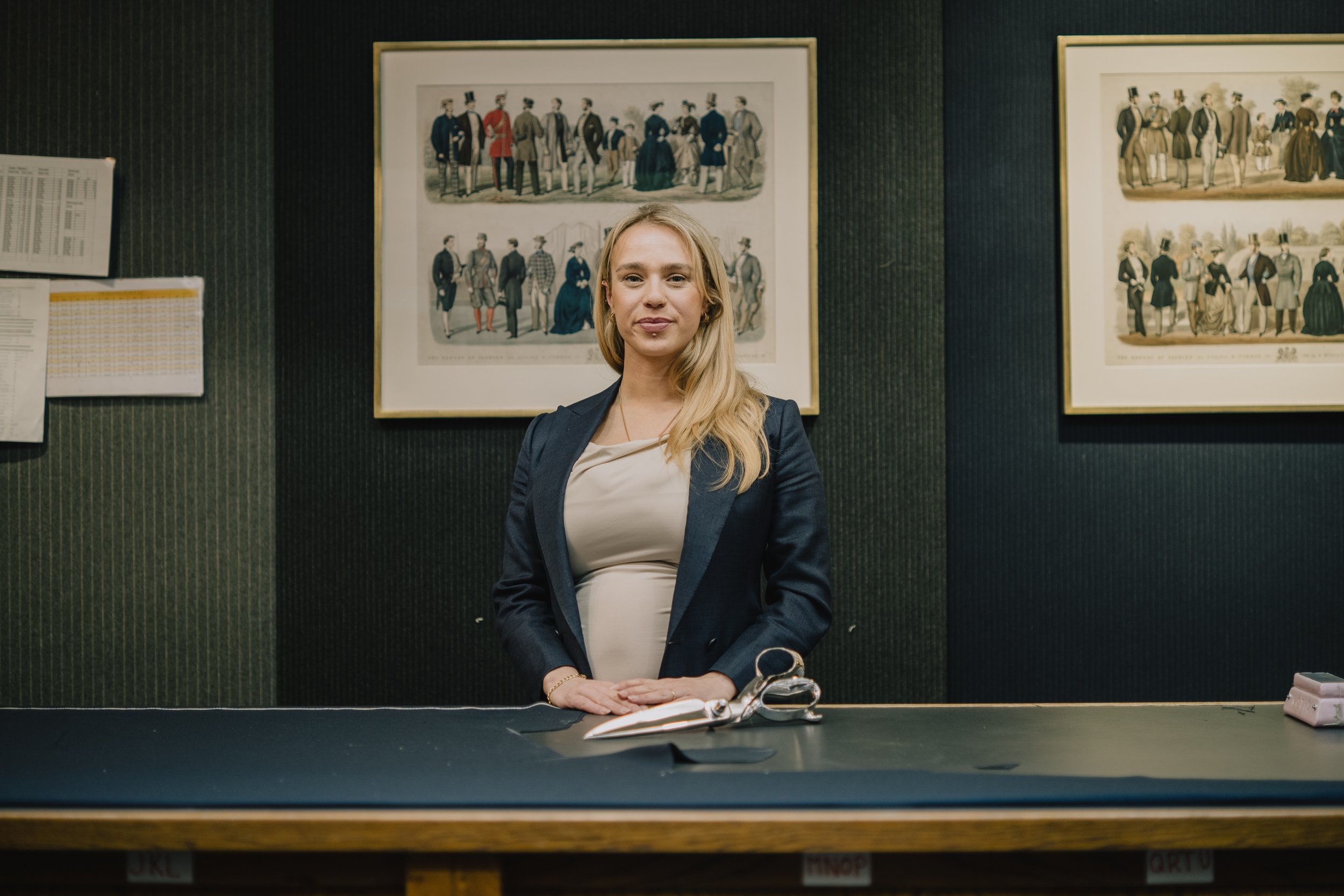
Freni Perry, behind her cutting table at Huntsman Savile Row.
from school trips to the textile museum to cutting bespoke garments at huntsman savile row, freni perry’s career has been shaped by a lifelong appreciation for cloth, craftsmanship and people who make. we joined the cutter to discuss tailoring, tradition and why the classic suit will never go out of fashion.
interview by fern merrills
Q: How did growing up in Huddersfield shape your early understanding of textiles?
A: Growing up in Huddersfield I learned so much about cloth and about the clothmaking process. All my school trips were to the Textile Museum, where we would learn about carding and spinning. Weekend walks would be around the mill pond. You’d go for coffee with your mates at The Carding Shed. I would wait for the school bus on the road in between Birkby and Huddersfield town, listening to the sound of the looms in the distance.
But it wasn’t until I moved to London that I realised just how famous Huddersfield was. Our sales team would be using the Huddersfield name as a selling point for this beautiful worsted wool. It made me really proud to be from Huddersfield, but it also made me sad that I hadn’t appreciated that when I had been living there.
Q: What first drew you to tailoring?
A: I studied fashion design at university and did a placement year supplying men’s tailoring to highstreet brands. In that year I worked with an incredible garment technologist, a former tailor called Lawrence Rubinstein. He taught me so much about the precision of tailoring, much of which we couldn’t implement with our highstreet suppliers. It was really fun to work on and made me understand and appreciate real tailoring. I just couldn’t get on board with the fickleness of fast fashion and I thought, there must be a way to do this with a bit more soul.
So after my degree, I enrolled at Newham College where I learned about hand sewing and bespoke tailoring. Then I walked up and down Savile Row until someone got annoyed at me and gave me a job - and here we are!
Q: How would you describe your role as a cutter?
A: My role as a cutter is essentially to turn 2D into 3D. I look at the customer and I take their measurements, and I consider many things about their figuration - how they stand, their posture, their personality even. I take all those things and create their paper pattern. I then have to work out how that 2D pattern is going to translate into a three dimensional garment. It’s sort of like writing the language of the garment to work out how the customer’s figure and personality is going to blend with the cloth, the trimmings, and the coat maker’s handwork.
Q: What distinguishes Huntsman’s approach to tailoring?
A: Our house style is very distinctive. Huntsman’s heritage is steeped in equestrian wear so it’s all based around the riding jacket: a nice high waistline, a high armhole and a strong shoulder angle. It was originally designed so that when you’re on a horse, everything is sitting high on the body and you’re able to ride without any obstruction.
We’ve kept that going throughout our silhouettes, so all of our ready to wear has a slanted pocket and one button fastening. I think this look is so timeless and classic. It fits in with every idea of masculinity and is a very flattering style as the slanted pocket and the one button points towards the smallest part of the waist, which will in turn accentuate the chest as well. Customers can have whatever they want in a bespoke garment, but 90% of the time people come here for that look.
Q: How do you approach the relationship between tradition and contemporary design?
In tailoring, form and function sits hand in hand. Anything that is beautiful is beautiful because it is functional as well. There’s no point in having a pretty item if it doesn’t have purpose. That’s what differentiates Dugdale from a lot of other cloth merchants. The design is not just about the form, it’s about the function. It feels like it is designed with the making in mind. The weights of Dugdale cloths and the finishing and the weaving… they lend themselves really nicely to coat makers and trouser makers. But Dugdale is also still pushing for new innovation and design. So it’s really taking those traditional elements of tailoring and making and creating new styles and colors that bring it forward into something that’s very contemporary.
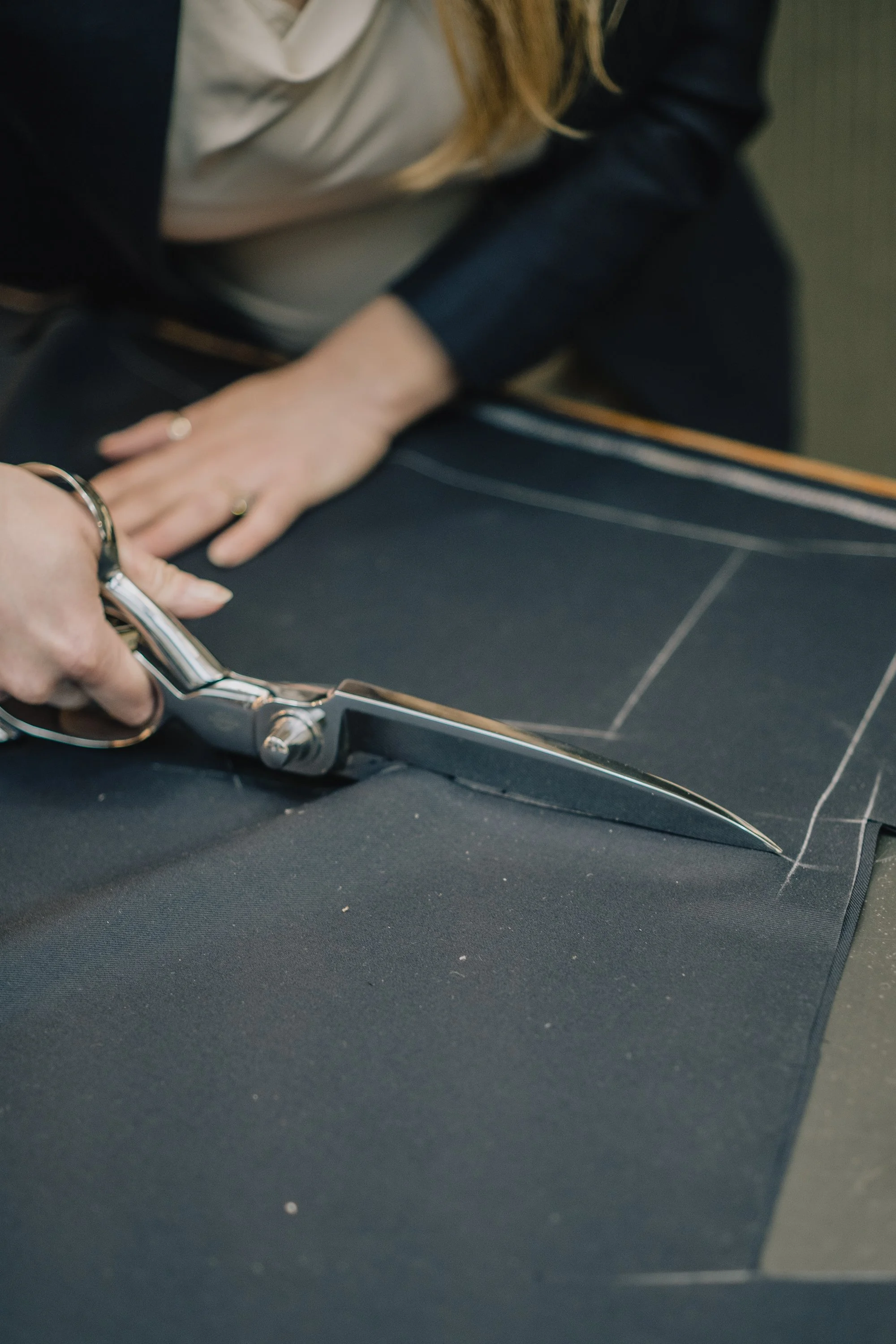
Freni at work in Huntsman.
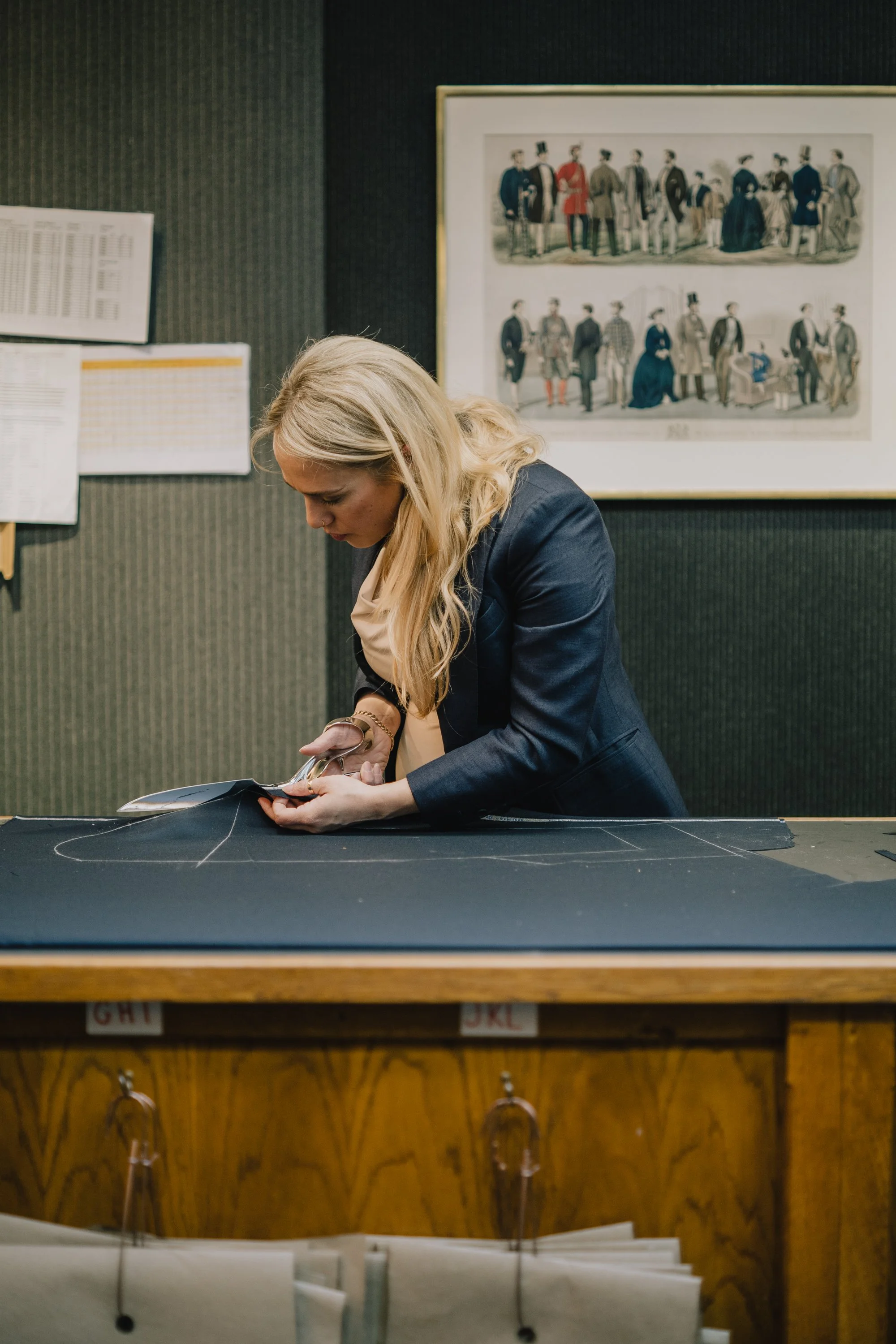
“At Huntsman they’ve really championed me as a female cutter” says Freni.
Q: From a technical perspective, how do you like cloth to perform on the table?
A: Dugdale cloth is usually quite tightly woven and so lends itself really nicely to shaping, which is a real art form and something our tailors put a lot of time and effort into. With a trouser, for example, you want a lovely S shape through the leg to give room for the calf and the thigh. With some cloth, you can shape and steam it and it might stay for a few minutes, but as soon as someone wears it, that form is going to go. If a cloth is too lightweight or too open, they just don’t work. But Dugdale cloth has that traditional feel and handle that lends itself really nicely to being manipulated with steam and heat.
Q: Are there any cloths or collections you love working with?
A: Yes. My favorite at the moment is Dugdale’s Tropical Breeze. It’s on the lighter side of a mid weight, about ten ounces. The high twist yarn means it travels really well and doesn’t crease. Usually with a high twist yarn, you get a bit of a scratchy or a rough texture to it. But Tropical Breeze has this really lovely, soft, buttery feel to it, while still performing like a high twist travel cloth.
Recently Rob [Charnock, Dugdale owner and chairman] brought round the new ‘1896 Rare’ four ply high twist that’s coming out with the London shrunk finish. I’m excited for that bunch to come out, too.
Q: Can you talk a little bit about your experience as a female cutter?
A: When I first started and was looking for a job, I found it quite difficult as a woman. I felt that I wasn’t taken as seriously as my male counterparts. And that was for quite a while. But as soon as I found my home at Huntsman, and met Campbell Carey [Huntsman’s Creative Director], a lot of that went away. There’s an inherent culture that can creep in sometimes in male dominated industries, where women aren’t taken quite as seriously or have to prove themselves a little bit more. But Huntsman systematically squashes that. I can’t speak for many other places as I’ve worked here for so long, but at Huntsman they’ve really championed me as a female cutter.
Campbell was my teacher when I was an apprentice. He pushed me so much to be able to be taken that seriously by everybody. Customers, other cutters, sales team - he left no room for anybody to question me. And then more recently, with me expecting my first baby, our whole management team have been so supportive. They’ve written an incredible maternity policy for the whole team, which I think is going to be a bit of a benchmark for Savile Row and for women cutters especially.
Q: How do you feel the landscape of tailoring is evolving?
A: I think Savile Row and bespoke tailoring is becoming a lot younger. You’ve got really young teams everywhere. People are moving around. And I think the youth of the teams is bringing a lot more innovation in terms of design and technique into the industry. At Huntsman we’re all really encouraged to try new techniques and I think it really pushes the industry onto keeping fresh and keeping innovative. You’re also seeing younger and younger customers coming through and I think that’s a great thing, because it shows that even though we’re keeping tradition, tradition will always be desired. Ultimately, a classic suit will never go out of fashion.
Freni Perry is a cutter at Huntsman Savile Row. Originally from Huddersfield, she trained in bespoke tailoring before joining one of Britain’s most respected tailoring houses. @hunstsman
All featured photography by Arran Cross.