
where the rivers meet: the story of huddersfield’s textile industry
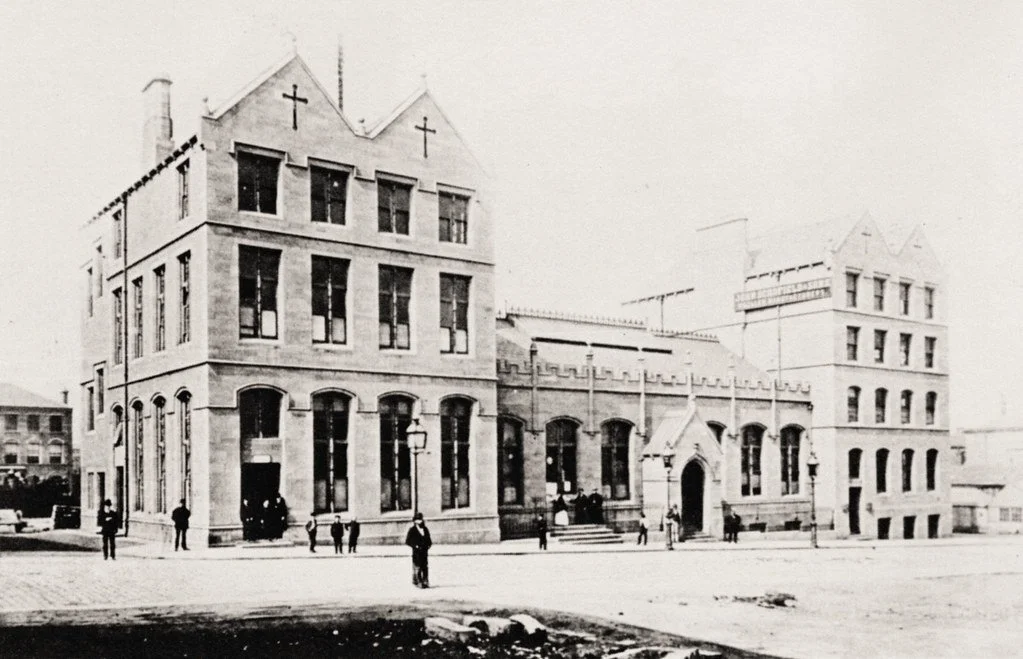
The Dugdale Towers as seen in the early 1900s.
in the first instalment of this series on the history of cloth in huddersfield, historian vivien teasdale explores how the town’s unique setting provided the geographical foundation for a booming textile industry, and how key enterprises like dugdale bros. & co., would go on to build an enduring legacy.
by vivien teasdale
A Landscape Shaped by Water and Stone
There are the valleys and the hills. Coated with rich, dark peat and purple heather, cut through with rippling becks that race each other down the hillsides to the fast-flowing rivers below. The Fenay Beck that cleaves the Lepton Edge, the rivers Holme and Colne that carved out two deep valleys, and the hard stone of Lindley Ridge that looks out over the landscape. All lead down to the flatter land, where the rivers meet before flowing on to join the River Calder, then the Aire and eventually out to the North Sea.
It was in this landscape that Huddersfield’s iconic architecture of stone-built cottages and three-storied terrace-houses with “weaver’s windows” was built. Huddersfield’s small, textile cottage-industry was quick to reap the benefits of innovative ideas, building small mills near streams, then larger mills down in the valleys, powered by steam and filled with new machinery.
As the town grew, industry was able to take advantage of the canals, the roads and railways which carried their goods to the ports of Hull and Liverpool, out to Northern Europe and westward to America. In return, new ideas, new raw materials and commodities arrived to be wondered at, used, and adapted.
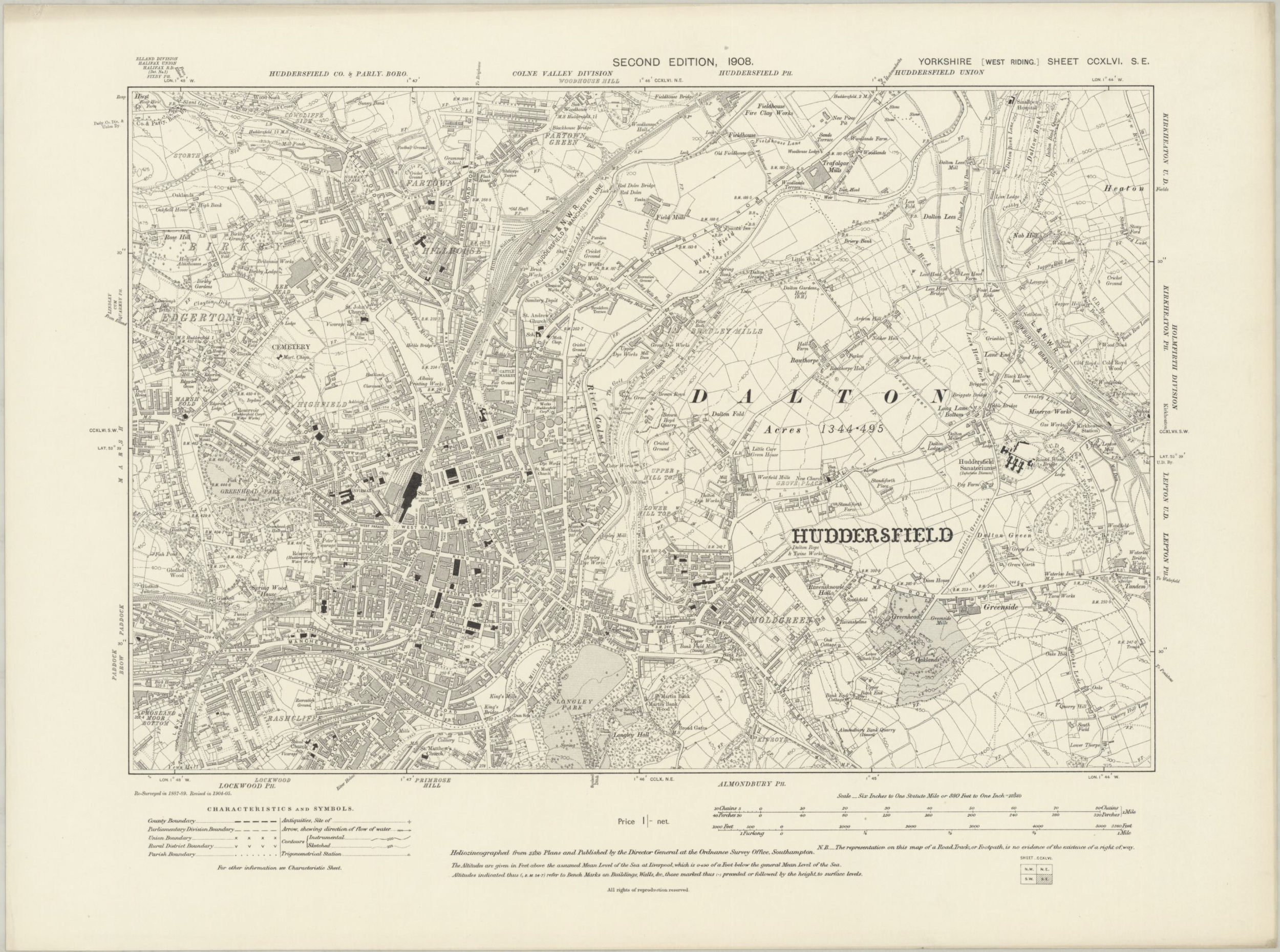
Huddersfield in 1908. Reproduced with the permission of the National Library of Scotland.
1851: Huddersfield Meets the World at The Worlds Fair
In celebration of just how far British manufacturing and making had come, Prince Albert proposed the first ever world-wide showcase of the country’s industrial power. The Great Exhibition of the Works of Industry of All Nations would take place at the purpose built Crystal Palace in 1851 and would attract over 13,000 exhibitors from around the world. Exhibitions ranged from machinery and textiles to fine arts and raw materials. Among the exhibitors were a number of Huddersfield textile manufacturers, many of whom won awards for the quality of their woollen and worsted.
The Great Exhibition attracted over six million visitors from across the British Isles. Railway companies even provided special trains and cheap tickets so that ordinary men and women could attend. Among them were hundreds of workers from the Huddersfield mills. Inspired and invigorated, they returned with pottery, fans, cards and handkerchiefs for their families - items that were not just souvenirs but tangible representations of experiences that broadened perspectives and motivated progress.
The Dugdale Family and the Beginnings of a Textile Legacy
Around this time, a Lancashire cotton weaver decided his real vocation lay outside the textile industry. He became a Congregational Minister in the city of Manchester. Little did he foresee that, within a few years, he would haveleft Lancashire for Huddersfield, and that there his sons would found the business that became Dugdale Bros. & Co.. Though all the Dugdales were staunch supporters of the non-conformist church, being quietly involved in many charities and good works throughout their lives, none of the children followed their father’s vocation. Instead, they each followed local tradition and went into the textile industry,which spread from the hills down along the valleys or clustered into the town itself.
The Dugdale girls became milliners, dressmakers or workedin Berlin woollens (a type of needlepoint). Robert Dugdale began work with Joseph Dyson & Sons of Milnsbridge and,over twenty-five years, worked his way up to being cashier before joining the Dugdale partnership. Fred and Henry Dugdale both worked in woollen warehouses, where Fred became a pattern maker, responsible for designing the cloth itself. Only the eldest, George Dugdale, pursued a career outside of Huddersfield, opting for a life at sea and returning to the Yorkshire town in later years, by which time much hadchanged.
It was Henry who first established his own business. Setting up in 1893, he initially sold remnants and trimmings but soon upgraded to better quality goods, creating bunches for suitings and trouserings. Fred joined him three yearslater and in 1896, they formalised the partnership: Dugdale Bros. & Co. One of the company’s first collections would be Fearnought. Introduced in the early 1900s, Fearnought was Dugdale’s first cloth made entirely from Australian merino wool, embodying Huddersfield’s central role in the global industrial revolution.
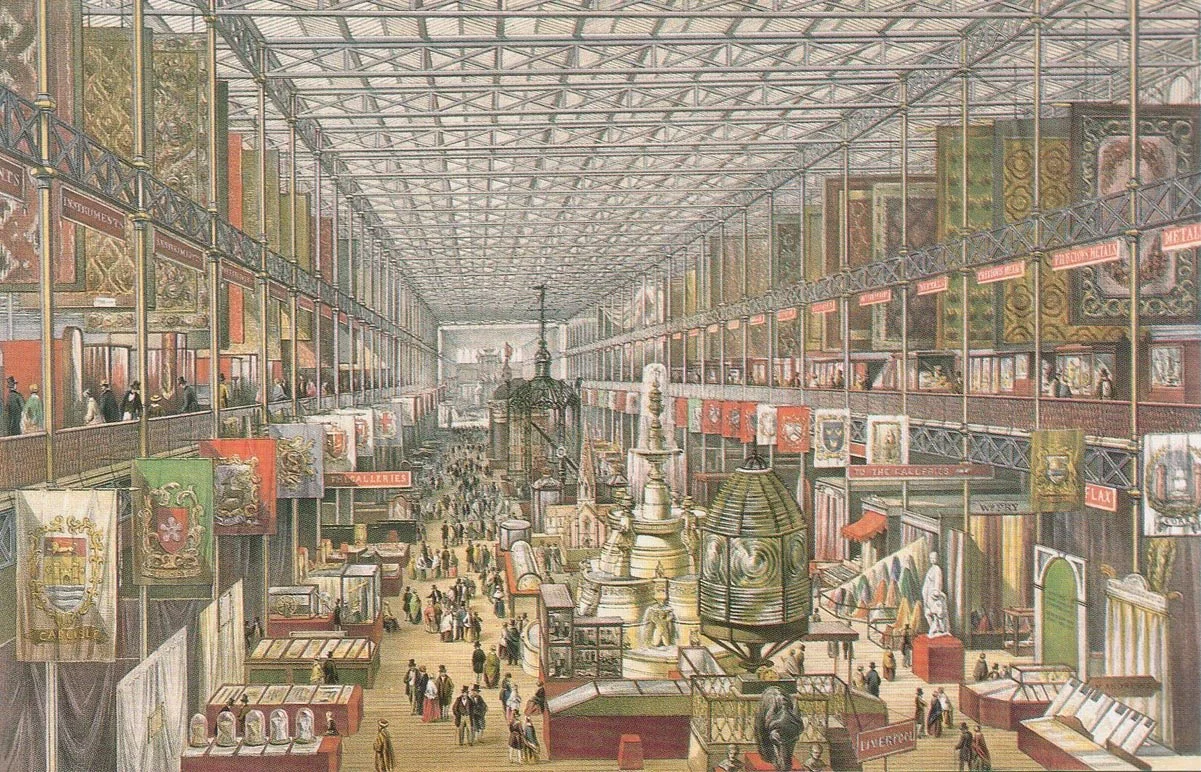
Inside the 1851 World Fair at Crystal Palace.
Change, Challenge and Yorkshire Tenacity
Due to more and more foreign competition, the textile industry had suffered a decline during this period. Tariffs on imported goods were introduced by US President, William McKinley, causing further loss of markets to the British textile industry.
And yet, Yorkshire tenacity kept the mills going. Businesses adapted their practices and ramped up advertising. The Dugdale brothers even ran a special competition, inviting their customers to write a ‘genuine and absolutely candid opinion’ of their Winter bunches, the winner of which would receive a free overcoat length.
Firms like William Thomson & Sons also prioritised the wellbeing of its workers. A keen follower of Ruskin, rather than keeping wages down and pressing workers for more effort, Thomson opted to change his company into a co-operative. He also continued to produce high quality cloth whilst refusing to use additives, preferring to stick to older, longer,methods (‘natural not artificial, quality not aggrandisement’ is still the maxim for Dugdale Bros. & Co. today).
Other businessmen in Huddersfield, though keen on profits, were also philanthropists. Henry Dugdale made no bones about the fact of their gifts to good causes. Fred, also gave support, though more quietly, preferring to “Do good by stealth, and blush to find it fame.” (Alexander Pope, An Essay on Man). Though their approaches differed, the two Dugdale brothers worked together in their own way, growing their business and establishing its reputation for the future. And then, at the beginning of a new century, the world changed once more. Queen Victoria, who had reigned for the past sixty-three years, died. Black crepe and bombazine predominated.
The Victorian age had ended.
Vivien Teasdale is a historian specialising in the industrial and social history of Yorkshire. This essay is the first in her series for 1896 exploring the foundations and enduring legacy of Huddersfield’s world-renowned textile industry.