learning to wear a suit: a personal history of women’s tailoring

An early experiment in tailoring.
for years, creative consultant and 1896 editor, fern merrills believed tailoring was about constriction and making herself appear smaller. it took several suits, a better understanding of cloth and a changing relationship with her own body to realise she had it backwards.
by fern merrills
Having a suit made had always been a dream of mine. At six feet tall, fast fashion wasn’t always kind to me. I’ve struggled through my fair share of too-narrow shoulders, too short sleeves and waistlines that sat an inch or more above where they ought to. And yet, when I had my first suit made, I still believed tailoring was synonymous with fit. And fit meant as close to the body as possible.
I was still in my twenties and lucky enough to be working with a Savile Row tailor. The suit itself turned out beautifully, but there are a few things I wish I had understood when commissioning it. In my naivety and excitement, I had opted for a very luxurious yet not at all hard wearing, lightweight Italian cloth. That was my first mistake. The second was the trouser shape. At the time we were at the tail end of the body-con era and tailored to me meant ‘fitted’. I had this idea that anything other than a slimleg would make me look bigger than I was (god forbid).
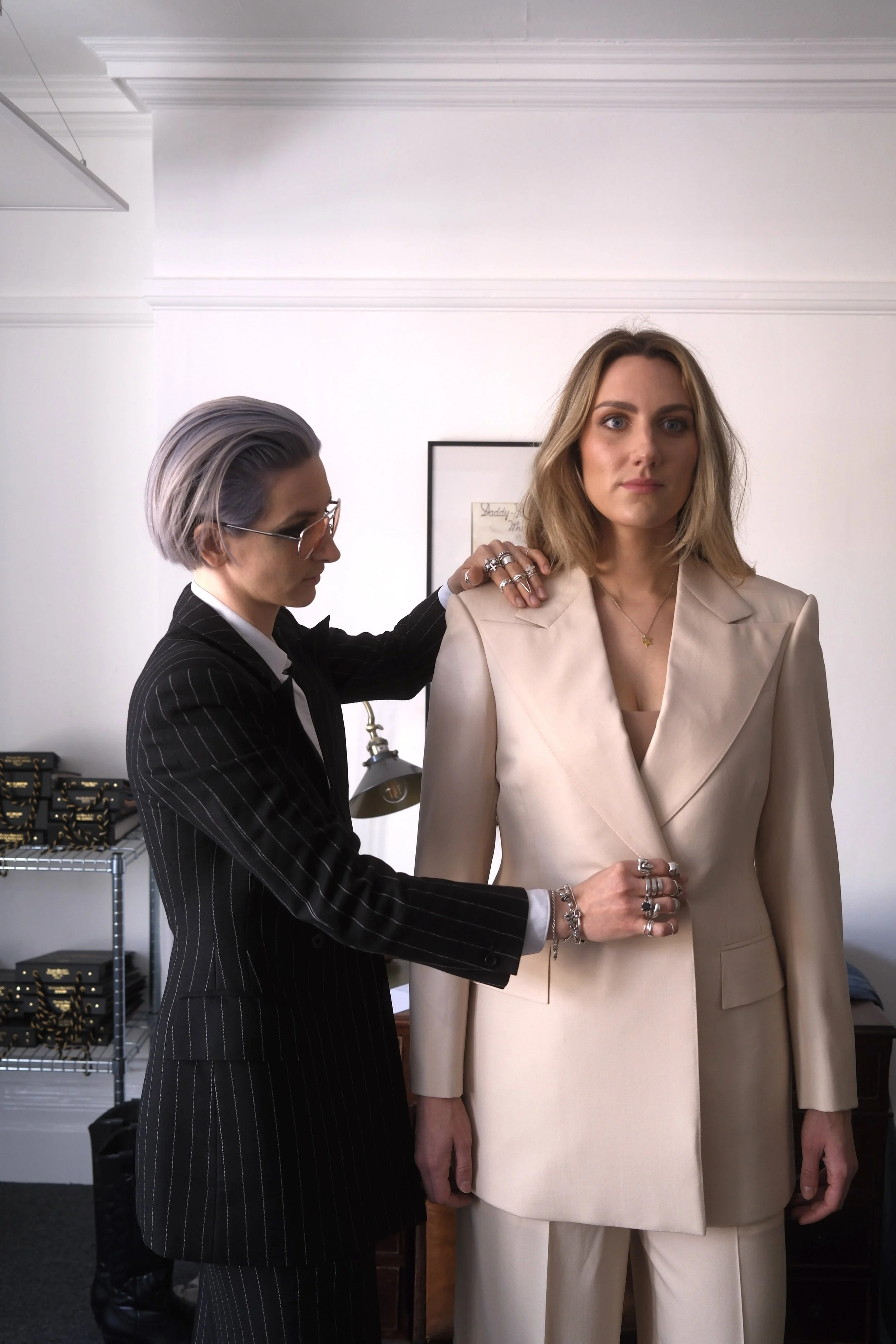
Fitting ‘the most precious suit’ with Kimberley Lawton.

Looking back, I realise I was less interested in dressing my body than disguising it and that, like many women of my generation, I had absorbed the idea that dressing well and looking smaller were one and the same thing. Despite the cutter’s gentle suggestion to keep a little room in the leg, the result was trousers that were simply too tight (I remember the right trouser leg, in particular, would ride up my calf as I walked along). Thankfully, the accompanying jacket had a little more latitude, and I’m pleased to say I still wear it to this day.
By the time an opportunity to commission another suit came along I had learned my lesson. I’d realised a good suit is something that you wear; not something that wears you. I had also begun working with Dugdale Bros & Co. and my understanding of cloth had moved on significantly. I was no longer interested in flimsy, so-called ‘luxury’ fabrics. My second suit was a single breasted two piece cut from a Dugdale navy hopsack from their English Classics bunch. Made to measure but with significant tweaks to the manufacturer’s block, this would become my most versatile suit to date. But the first fitting was not without challenges.
I was by now 18 months postpartum and my body was in constant flux. The double pleated trousers were the perfect length and cinched my returning waist to perfection, but they needed letting out a little at the seat. More significantly, the jacket, having been designed on a women’s block, made me look, well, a little matronly. The princess seams and cropped body felt dated and not in keeping with my proportions or style. My tailor had a solution. Pulling out a navy jacket he had brought to town for one of his male clients, he urged me to try it on. The difference was immediate: a longer line from shoulder to seat, a sharper, more defined shoulder and a silhouette that felt both timeless and contemporary. This was it. This was the look. Yes, the shoulders needed a little tweak and the length needed an inch or so more, but the classic, masculine silhouette worked.
This was the point I stopped viewing tailoring as a tool for minimising myself - as another way of submitting my body to the expectations of the male gaze. For the first time, I was interested in clothes that worked with my proportions rather than against them. So what if it was a ‘men’s’ jacket? It fit. And that’s what mattered. Being born at the end of the 1980s, the decade’s eponymous power suit lingered in the collective consciousness long into my childhood. From Julia Roberts’s Bermuda shorts suit in Pretty Woman to Catherine O’Hara’s wide-shouldered jackets in Home Alone, this was the version of women’s tailoring that had always occupied a corner of my imagination. It wasn’t about shrinking the body down to its smallest size. It was about presence and confidence. It was about framing the body, not clinging to it. Allowing movement rather than restricting it. Looking back, it’s no surprise that I eventually found my way back to these broader silhouettes that emphasise the female form instead of minimising it.

Dugdale Linen ‘marshmallow pink’ short suit in New York.
Further suits have followed the same principles. From an eighties inspired, marshmallow pink linen short suit with double breasted jacket and voluminous, double pleated shorts, to a simple green check two piece in a crease resistant travel cloth (Dugdale’s Tropical Breeze), each new commission has been designed with my own form - and my own comfort - at the forefront.
Because now in my late thirties, I am no longer interested in making myself smaller. Nor do I care for garments that restrict my body. Il faut souffrir pour être belle (‘one must suffer to be beautiful’) has long been the accepted maximfor women with an interest in clothing. Tight waistbands, impossible shoes and garments that demand we hold ourselves a certain way have often been presented as the price of looking good. On the contrary: women’s tailoring, done properly, should not feel like a straitjacket. A suit should not hinder movement nor be incapable of accommodating fluctuations in waist circumference. A suit should fit us, during each phase of our monthly cycle, and for years into our future.
A good suit should adapt to your body, not demand that your body adapts to it. One final piece of advice: always ask for side adjusters.
Fern Merrills is a creative consultant specialising in tailoring, luxury menswear and British manufacturing. Having worked alongside Savile Row tailors, British cloth merchants and manufacturers for more than a decade, she writes on craft, clothing and contemporary style. She remains a firm believer in broad shoulders, British cloth and side adjusters. @this_is_fern_